
Portals: queer intergenerational connections, history and memory
There is a particular kind of archaeology involved in revisiting objects packed for safe keeping decades ago.
I sit cross-legged on my sister's living-room floor with a box between my knees: hardcover sketchbooks bound in black, heavy with newspaper clippings, photographs, costume designs, zine layout sketches, notes from lovers, stray thoughts scrawled in moods I have since discarded. The pages pulse with the anti-establishment, anti-authoritarian, furiously alive DIY ethos of Generation X. The era feminists discovered we can fight patriarchy while wearing Doc Martens and fishnets stockings.
One entry stops me cold. In green ink, in my own hand: Today I pissed over more mouths than toilet bowls. I snap the book shut. My stint as a dungeon dominatrix, captured in a single pithy sentence.
What happened to that punk energy? Though still a card-carrying feminist, I have lost my zest. These days, I play it safe. Challenging mainstream taboos no longer holds the appeal it once did. I have more to lose: a stable career, financial security, patience, harmonious relationships with family members. I now treasure my privacy.
But delving into these boxes, I decide I am finally stable enough to embrace my brazen past. I have been too hasty to tidy up my life. Objects clutter the psyche. But they are also portals to lost parts of ourselves.
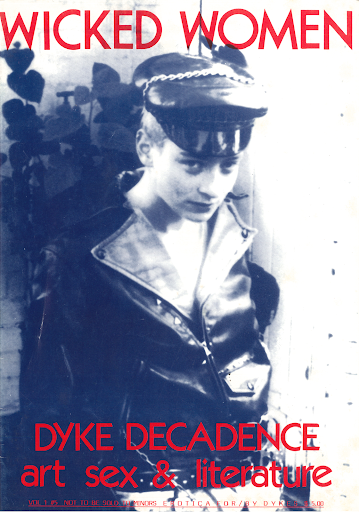
Tiger Salmon photographed by Jasper Laybutt for the cover of Wicked Women magazine in 1988. Wicked Women collection, Australian Queer Archives.
Nick Henderson manages acquisitions at the Australian Queer Archives (known as AQuA). It was his call for donations that prompted me to retrieve the box. Ephemera like journals and costumes, Nick told me, are the archival mortar: the material that gives context to a collection. AQuA already attracts pilgrims—scholars and artists—eager to research the ‘Wicked Years’, the decade or so when Jasper Laybutt and I published Australia's first lesbian sex magazine Wicked Women(1988-1996). So I carted the box of ephemera over to the Pride Centre in St Kilda, where AQuA is now housed. Inside, a couple of volunteers were at work: one cataloguing protest buttons, the other there to meet me.
That's how I met Gab.
Gab is an open-faced young dyke who is completing a postgraduate degree in records management and archives. They set up the sound equipment with nimble fingers, tested the microphones, then unhooked a set of keys that hung from a carabiner on their left hip. I braced myself, out of old habit. Journalists in the nineties had used a particular style of question, engineered for tension, mining for spectacle, probing Jasper's gender transition with prejudice dressed up as concern. The titillation of drugs, sex and transgression had been irresistible.
Gab asked me instead about my home.
"Tell me about the share-house," they said. "Where did you and Jasper first meet? Was it love at first sight?"
It felt like we had all the time in the world. This gentle curiosity was a balm on wounds I had not realised were still tender. I settled into my newfound role as a queer elder, and we began to talk.
Gab explained that queer history is comprised of multiple stories. That they aim to collect as many as possible while queer elders are still able to give first-hand accounts. Born in 2001, Gab belongs to Generation Z, the first digital-native generation, raised entirely within the architecture of the internet, social media, smartphones. As children of Gen X, these Zoomers are characterised by their social consciousness, and their pragmatism in response to a unique convergence of pressures: climate anxiety, housing unaffordability, student debt, and a social life mediated through platforms that surveille and monetise intimacy.
This generation has highly developed emotional intelligence. They are too polite to brag about it, but they run rings around us.
They also have the lowest recorded optimism of any generation in recent history.
Zoomers carry a kind of grief by proxy. They yearn for a queer history that never made it onto a high school curriculum. When they discover the nineties dyke scene—with its raucous parties, radical experiments in communal living, and sex-positive politics—their admiration is laced with a complicated envy. They have a nostalgia for a time they never lived. A longing for the period before social media's surveillance, before the algorithmic policing of queer bodies and desires.
Once again it is risqué to parade around in a black lace bra.
Instagram's content moderation, designed ostensibly to protect, has proven incapable of distinguishing between exploitation and subcultural expression, between harm and education, between pornography and the radical visibility of a queer body asserting its own existence. The wheel has turned in a direction none of us anticipated. We rebelled against the puritanical sanitisation of dyke sexuality that came from within our own ranks. The lavender lesbians who told us that lipstick was a betrayal, that penetration was ideologically suspect. We thought we'd won that argument. And now here is a new generation, fighting a different version of it, on a different terrain.
Back in the nineties, I broke the locks on an abandoned warehouse and moved into a neighbourhood perfumed with hops from the nearby brewery. A mate rigged up water and electricity, and we created something liveable. By this point, punk had migrated off the mosh pit and into everyday life. It no longer required a mohawk or studded collar. It was a generational reflex: challenge the taboo first, consider the consequences later.
A gang of us regularly met at our local café, Badde Manors, to drink spiced chai and drum up ideas for parties. Jade was crushing on Mira, who served from behind the counter with her short-bobbed grace. Newspapers were scattered across tables next to flyers for squat parties and zine launches. One afternoon, Jasper pulled a notepad from his satchel. He read aloud the draft announcement for a new competition: Ms Wicked.
Daring dykes can enter in one or more categories: Femme Fatale, Leatherwoman, and Ms Sleaze, plus the compulsory categories of Judge Interview, Parade, and Fantasy Segment.
We were ardently anti-censorship. We never vetted the entrants. A dyke could be seen hollering from the audience one week then strutting her stuff on stage the next. The premise was simple: queer and trans women were to demonstrate their version of wickedness before a panel of judges. Inspired by International Ms Leather and Mr Drummer in the United States, we welcomed all manner of fantasies and identities. By then, Wicked Women magazine had been running for a couple of years, showcasing erotic storytelling by dykes for dykes, creating hot images, unapologetically exploring sexual fantasy. The emphasis was on open-minded sex positivity, not ideology. Editors and readers both understood the distinction between fantasy and reality, a distinction our critics never seemed inclined to grant us.
We were furious that lesbian sexuality was so often muted by social demands for women to be passive, receptive, compliant. Cultural instructions about sex are prescriptive: it happens behind closed doors, between the sheets, in configurations that centre no woman's pleasure and certainly not a dyke's. Ms Wicked was an antidote. The magazine's stories would come to life on stage in performances that were raw, funny, dangerous, tender. A living archive of desire, defiance, and dreams.
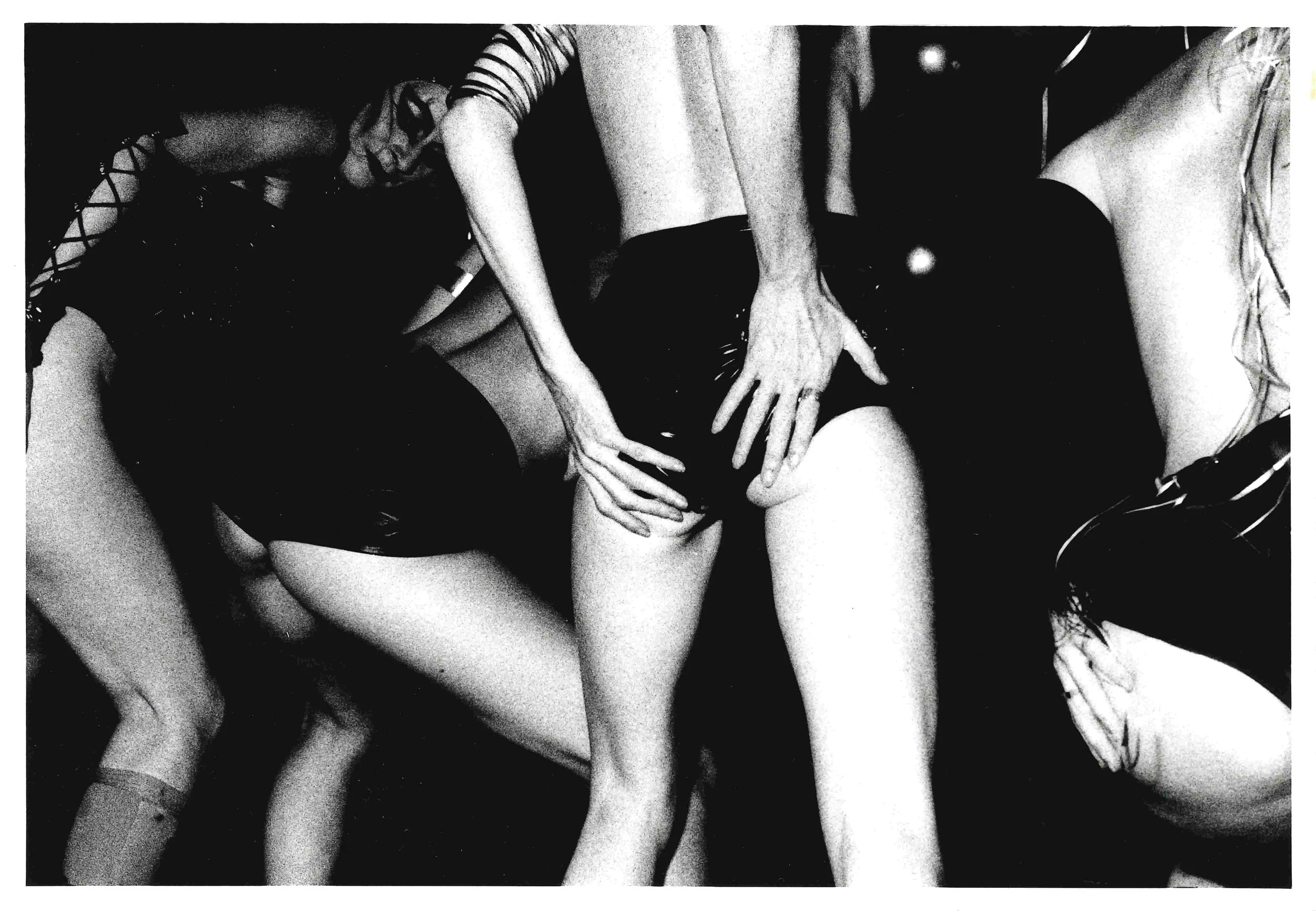
Ms Wicked performance 1993, photographer unknown. Wicked Women collection, Australian Queer Archives.
The night Azaria entered the Ms Wicked heats, a group of butch dykes lugged her requested prop onto stage: a heavy cast-iron claw-foot bathtub. The butches liked to flex to the waiting chorus of high camp femmes ready to coo and admire the muscles. The gender play was done with tongue-in-cheek aplomb; all except the heat of it, the genuine turn-on.
The audience stood crammed in tight. I sat with the judges directly in front of the stage, in the splash zone.
The curtains opened to reveal Azaria stepping into the bath, her dirty blonde tresses gathered into a knot at the top of her head. She swooshed up and down the tub, rubbing jelly over her body to the sound of Pussyfoot singing ‘The Way That You Do It’. Towards the back of the stage, a line of servants stood waiting, their bodies naked beneath clear plastic aprons. These queers of all genders were known as the Brumby Gang; they lived together in a rambling house in Surry Hills. Azaria flung her ample tits about and called for ‘MORE JELLY’. The servants raised bucketfuls of red jelly and poured it over her, giggling. Then she sat up straight, clung the edge of the bathtub, faced the audience and hollered: ‘BRING ME MY SISTER!’
A moment of genuine silence, the pendulum at its fulcrum. Incest is a powerful taboo; many of us in that room were survivors. But in this moment, the control was ours. Her sister, a short haired, impish version of Azaria, entered stage left. The crowd roared. More jelly was poured. The splash zone extended beyond the first two rows. The sisters writhed and plunged as jelly was supped from flesh. The collective roar from the audience acknowledged that even this taboo could be claimed, reclaimed, turned inside out into something triumphant and communal and absurd.
Azaria and her sister were both fixtures on dyke dance floors; they were lesbo-related to me, as it happened, through a complex web of ex-lovers and overlapping relationships that we would now call a polycule, though we had no word for it then. We were finding language as we went, the way you do when you're living faster than the vocabulary can catch up.
I watch Gab’s face move through several expressions as I tell this story. They are fascinated. They are also, I think, quietly startled. Not by the jelly wrestling, but by the density of community it implies. The fact that everyone in that club knew the colour of each other’s bedsheets, knocked without calling first, dropped in for endless cups of tea, had slept with each other's exes, choreographed performances in each other’s living rooms, and shown up to carry bathtubs onto stages. That is what registers as strange and precious to a generation that built its social life through a screen.
My nostalgia for those nights is real, but it is not clean. The raucous camaraderie of Ms Wicked was not yet bolstered by the language of consent. The crowd was marinated in bourbon and beer; being touched without invitation was considered a risk you absorbed when you entered the room. “No” was a word many had not yet learned to say or hear. I would not have tolerated groping from a straight man, but it was expected in a queer zone. My only recourse was to shove them aside and toughen up. That toughness was survival, and many of us carry those wounds still.
We could also be blinkered in our politics. When I watch archival footage of those events, I clock the Indian headdress one performer wore in a Village People number. Though many in the Wicked community were BIPOC, we didn’t promote ethnic inclusion. It didn’t occur to us to prioritise wheelchair access. We thought we were fighting the right battles. We were clueless about others, and we were not always gentle with each other in the ways that genuinely mattered.
Gen X has its own accounting to do. My cohort is renowned for a sullen reluctance. There is a moody, dragging-of-feet around questions that our younger counterparts have moved through with more grace. The pronoun hesitations. The TERF-adjacent ideas that go unexamined, dressed up as concern or as hard-won feminist principle. The tendency to dwell on the dyke drama, to let old wounds keep us separate and stuck. We fought so hard that even our joy was an act of rebellion. But some of us have been unable to stop fighting long enough to notice that the enemy has shifted, that our shields are aimed in the wrong direction now.
There is a particular kind of pain in being corrected by someone younger than you. I know this. There is also, if you can breathe through the initial defensiveness, something extraordinary to learn in that moment.
Gab poses careful questions. They are too polite to brag about their emotional intelligence, but it is evident in everything: in the way they set up the microphones, in the quality of their attention, in the questions they do and don't ask. They are building an archive of queer oral history, which means they are in the business of preservation. They hold, with care, the fragments that communities have left behind.
What Gab and their generation seem to understand, intuitively, is that queerness is not reinvented with each generation. It is transmitted. Imperfectly, through gaps and silences, through the boxes people leave at archives on weeknights, through VHS tapes and zine collections and the memories of people who are still alive. History is not something that happens to queer people. It is something we make together, across time, across the distances between generations that can feel unbridgeable but can, in fact, be broached whenever someone is willing to ask.
At Midsumma Carnival this year, a drag king tore off his business suit to reveal a spangled leopard-print cowboy getup. It’s the same energy of Ms Wicked in 1992. But this time, instead of an audience of raucous horny lesbians, the drag king gave high fives to ten year olds gripping the edge of the stage. A crowd gathered, drawn by the colour and chaos. The kids looked back at their smiling mothers and danced. The lip-syncing is considerably more polished now. No one got naked, but the need is the same: to break free, to be seen, to take up space, to make a crowd roar.
We let loose with costume. We always have. It is one of the great queer traditions. The transformation, the performance, the insistence that identity is not fixed but fluid and self-authored and endlessly revisable. Queers get to rewrite the script. Each generation writes it differently, in the idiom of its own moment and its own wounds, but the impulse is continuous.
I left my box of journals with Gab at AQuA. The green-ink note about golden showers, the zine layouts, the notes from lovers are all now part of a shared archive. Objects that cluttered the psyche. Portals for a community.
But revisiting those years is not an act of nostalgia alone. It is a reckoning. With what we got right. With what we missed. With the ways our hard-fought freedoms were incomplete, and the ways we policed each other even as we raged for liberation.
And with the fire, still there. The restless yearning, the brazen hopefulness that I had decided, somewhere in the respectable middle of my life, was no longer quite appropriate.
What's held at AQUA is not a monument to the past. It is instruction for the future: this is who we were, this is what we risked, this is how we loved each other, this is what we should have done differently, this is what we knew without knowing we knew it.
Gab's generation look at what we made and see possibility. It was not golden age, nor a blueprint, but proof of concept. Evidence that our weirdness is wonderful. That queer community can be built from scratch, in abandoned warehouses, on lentil budgets, with butch dykes willing to carry heavy things and twinks willing to cheer. Progress is a team sport. And the team spans generations.
Tiger Salmon (they/them) is a queer artist from Naarm whose memoir writing tracks their role as an LGBTQI+ publisher and provocateur. Tiger launched Australia’s first lesbian sex-positive zine Wicked Women with Jasper Laybutt during the third wave of women’s sexual liberation in the early 1990s when the pursuit of pleasure was a powerful political protest. The zine evolved into a magazine that sparked a revolution in lesbian circles in Australia. Tiger now conducts exhibitions and events that celebrate dyke and trans beauty.